Remora
Bride of AlvarRemora is the gobli queen who rules Goblia from the mountains of Ferar and whose hostility to peace makes her a decisive antagonist in the conflict surrounding Lucy Hammond’s arrival in Underland. By sending a henchman to abduct Emily Hall and by attempting to have Lucy returned to Earth, she violates her treaty with Alvar and forces the threatened marriage between Lucy and Alvar into an immediate political and personal crisis.
Identity and Rule
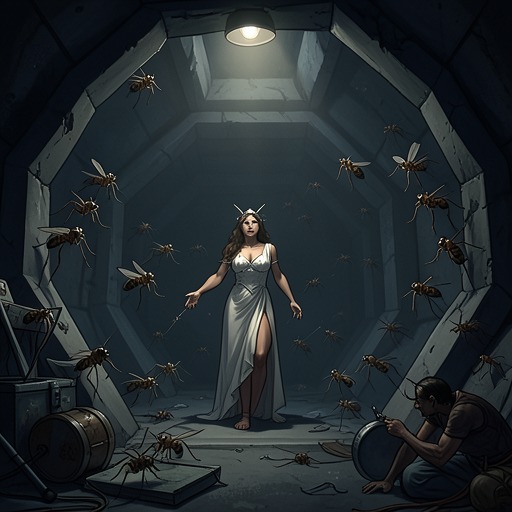
Remora is presented as the female sovereign of the gobli hive and as the queen who restored Goblia’s “old ways” after appointing herself ruler. Her appearance distinguishes her from the male gobli while retaining the species’ unsettling traits: she has grey skin, beady eyes, a tall and feminine form, slicked-back black hair, pointed ears, soft almost human features, and a large hooked nose. Her pointed teeth and scoffing manner reinforce the impression of a ruler who is both socially commanding and physically alien to Lucy.
Her government is inseparable from the hive’s reproductive and religious structure. Fletch explains that only one female is permitted to live in a gobli hive at a time, because Goblia follows a religion established around one of the Great Matriarch goddesses. Male drones generally die in infancy, female offspring are destroyed unless Remora selects one to become a future princess, and Remora lays approximately ten eggs each week as the hive’s reproductive source. The system produces widespread inbreeding and severe bodily deformity among the gobli, making Remora not merely a monarch but the biological center of the society she controls.
Conflict with Alvar and Lucy
Alvar identifies Remora as the queen who sent Maggort, a gobli lord living in the mountains of Ferar in Goblia, to seize Lucy. He says that Maggort wanted Lucy because Remora and her queen did not wish for peace. The abduction is politically significant because Lucy is not simply a traveler: she is the Earth-human bride promised to Alvar under the Earth–Axus marriage agreement, and her marriage is intended to secure peace between Earth and the realms of Axus.
Remora’s scheme also captures Emily, but her forces discover that Emily is not Lucy. Alvar reports that Emily has been handed over to Remora’s custody after the gobli recognize the substitution. He tells Lucy that the only immediate way to prevent Emily’s execution is for Lucy and Alvar to marry. Gobli justice makes the threat especially extreme: criminals are torn apart on the Star Wheel, with their limbs pulled off one at a time before the head. Remora therefore turns the distinction between the true bride and the mistaken captive into a weapon against both Lucy and Alvar’s diplomatic settlement.
When Lucy and Alvar reach Goblia, Remora responds to the crisis with apparent hospitality rather than apology. She dismisses the henchman responsible by saying that he fled, then invites her guests to rooms so they can prepare for a feast. Her welcome is a performance of sovereign control: the kidnapping is treated as an inconvenience, while the feast and the formal reception attempt to place the threatened victims inside her ceremonial order. Emily’s immediate wish to return to Underland reveals how little security Remora’s hospitality actually provides.
Political Opposition and Defeat
Alvar publicly frames Remora’s actions as a breach affecting all of Axus, not only himself. In front of the gobli living outside the depths of the mountain, he declares that Remora has broken a critical treaty by insulting him through the kidnapping of his bride. He states that she intended to send Lucy back to Earth and announces that he will dethrone her and help the gobli establish a new ruler of Ferar. The crowd answers with the chant “AYA-ALVAR, AYA-ALVAR,” and deer-people from the surrounding forests join the gathering, showing that Remora’s opposition has created a broader coalition against her.
Remora’s defeat is not followed by a negotiated restoration. Alvar explains that she killed herself and all her people rather than be vanquished by an enemy. In his account, she believed it more honorable to die by her own hand and bring her people with her into the afterlife than to accept defeat; she knew that she was outnumbered and overpowered. Her final act transforms the fall of Goblia into collective destruction. The queen refuses the political transition Alvar intends and makes the hive’s survival inseparable from her own refusal to yield.
Narrative Function and Significance
Remora occupies the antagonistic position in a story structured around competing forms of order. Alvar’s treaty seeks to connect Earth and Axus through marriage, while Remora’s rule preserves a closed hive system based on matriarchal monopoly, reproductive control, inbreeding, and violence. The contrast does not make Remora a simple opposite of Alvar: both rulers place political stability and succession within intimate bodies, but Remora enforces her order through captivity and execution, whereas Alvar ultimately seeks a new ruler for Goblia after judging her government intolerable.
Her actions also expose the cost of treating Lucy as a diplomatic resource. Remora’s attempt to seize the “true bride” converts Lucy’s body, identity, and marriage contract into the visible stakes of interworld politics. The crisis begins with a treaty and a promised queen, but it is advanced through kidnapping, threatened execution, and the demand for an immediate marriage. In that sense, Remora functions as the force that makes the arrangement’s coercive foundations impossible to ignore.
Within the plot’s larger movement, Remora is an antagonist who refuses the possibility of return or integration. Her defeat clears the way for a different political future in Goblia, while her death and the destruction of her people mark the terrible endpoint of a closed order defending itself against change. The narrative thus uses her not only to threaten Lucy and Emily but also to dramatize the collapse of a society whose ruler treats domination, reproduction, and survival as one indivisible system.